Fear and Trembling
A Free-Energy Model of Chronic Muscle Tension and Somatic Release

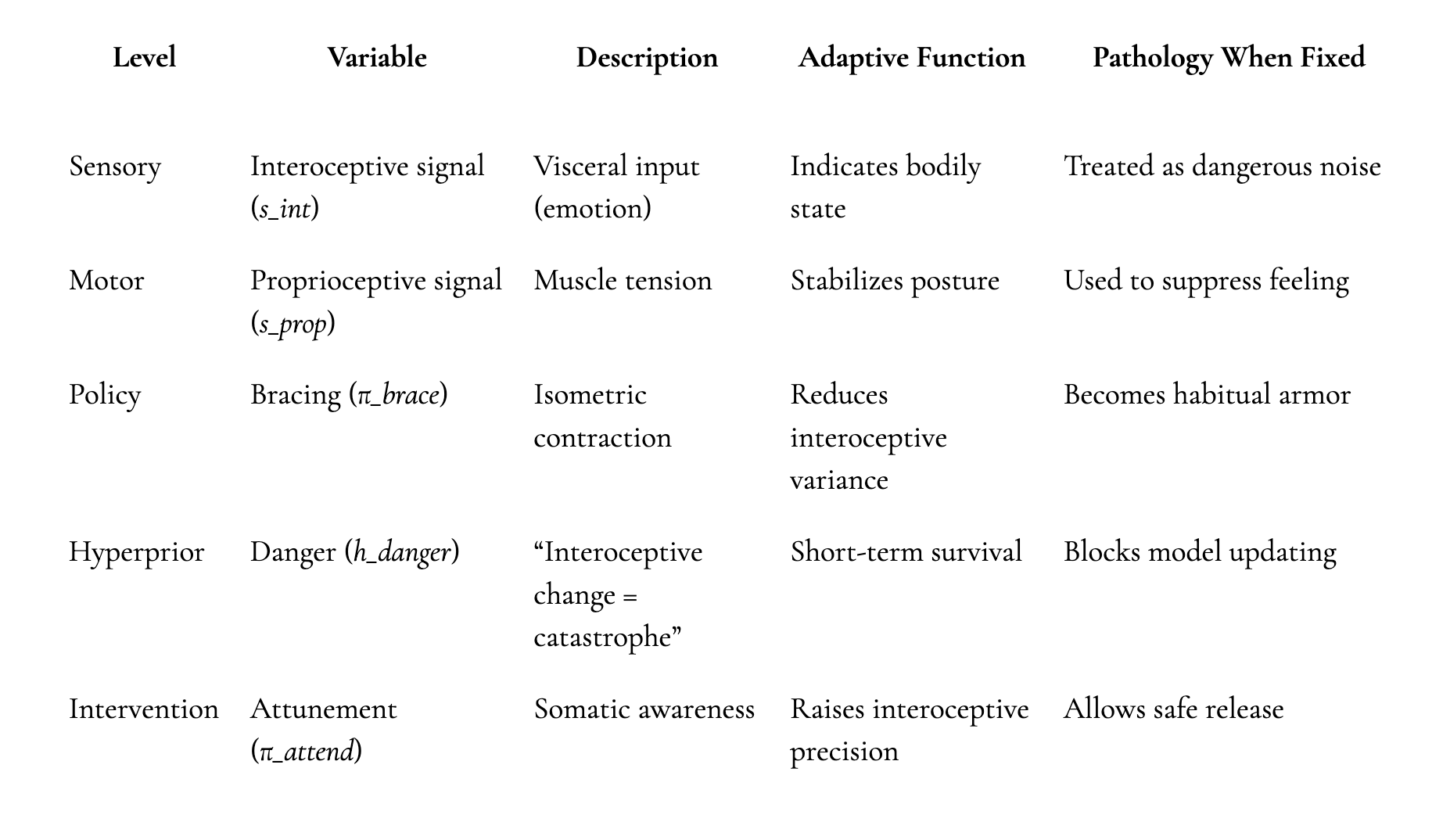
“Body armoring” functions as an active-inference policy—an embodied attempt to minimize prediction error by suppressing emotional signals at their source. Over time, this policy becomes hyper-prioritized, resulting in habitual muscular contraction, emotional blunting, and loss of interoceptive granularity.
Somatic and attentional practices are precision-reweighting interventions: they restore sensitivity to the very interoceptive channels the system has learned to distrust. Three experimental paradigms—stochastic mirroring, dual-signal gating, and stochastic resonance amplification—are proposed as testable means to shift the precision balance between interoceptive and proprioceptive channels.
1. Introduction
Across traditions—clinical, contemplative, and somatic—there runs a shared intuition: emotional suppression is not purely mental. It is enacted in the flesh. What if this embodied rigidity were not merely metaphorical “armor” but the expression of a specific computational policy—a way the organism has learned to reduce uncertainty about its inner world?
Chronic muscle tension represents a learned form of active inference. The body braces to keep interoceptive signals—those that carry the raw affective pulse of the viscera—within the bounds predicted by an internal model of safety. The consequence is an apparent calm purchased at the price of disconnection. Chronic tension is a living trace of dysregulation, a muscular overcommitment to a particular self-model.
From the perspective of the free-energy principle, every living system strives to minimize the difference between its predictions and the sensory evidence it receives. When the inner world becomes intolerably unpredictable—through trauma, shock, or shame—the organism may find it easier to change the body than to change the model. Bracing constrains sensation itself; by tensing the musculature, one reduces the amplitude of interoceptive signals. The self feels less, and therefore remains coherent.
But this coherence is brittle. Over time, the suppression of interoception reorganizes the hierarchy of precision weighting: the system begins to treat proprioceptive tension as the reliable signal and interoceptive variation as dangerous noise. A self organized around control cannot relax without feeling threatened.
The present model reframes the phenomenology of tension and release in these terms. It suggests that somatic methods of “inhabiting” or “softening” are not simply relaxing exercises but interventions at the level of predictive coding—methods for manually reweighting the precision of previously muted sensory streams.
2. Predictive Processing and the Interoceptive Hierarchy
At its core, the free-energy principle claims that living systems maintain their form by minimizing surprise. “Surprise,” in this sense, means deviation from what the organism expects to sense given its current model of the world and itself.
The nervous system operates as a hierarchy of predictions and prediction-errors. Lower levels process immediate sensory details; higher levels encode abstract regularities. Error signals flow upward when reality deviates from expectation, prompting updates to beliefs. Predictions flow downward, attempting to suppress those errors by anticipating incoming data.
Two broad classes of sensation concern us here:
Interoceptive signals — originating in the viscera, heart, lungs, gut, and endocrine states. They correspond to the felt body and underlie what we call emotion.
Proprioceptive signals — arising from muscles, tendons, and joints; they describe posture, tension, and movement.
Both classes feed into the same predictive hierarchy. In a balanced system, interoceptive fluctuations (the heartbeat quickening before public speech, the stomach flutter of attraction) are recognized, labeled, and integrated into an updated self-model. The body feels what it feels; the model flexes to accommodate it.
However, when the amplitude of interoceptive surprise exceeds tolerable bounds—when the organism cannot integrate the data without threatening its core identity—the hierarchy can invert its strategy. Instead of updating its beliefs, it may act to change the sensory input itself.
In active-inference language, this means switching from perceptual inference (update the model) to active inference (change the world). The world here includes the body. The act of tensing muscles is an action on the world: it alters the pattern of sensory inflow. A body held rigidly still sends less unpredictable interoceptive information upward.
Thus begins the logic of bracing.
3. The Genesis of Bracing
Imagine a child in a moment of acute social shame. The chest tightens; the diaphragm locks; heat rises in the face. These interoceptive signals are the body’s physiological account of the threat. But if the social environment forbids overt expression, or if the emotion itself is experienced as annihilating, their nervous system faces a dilemma.
One option is to update its model: “I am a person who feels shame; I can survive this.” That path requires high interoceptive precision and trust.
The alternative is to silence the signals. The brain issues motor commands that stiffen the musculature—especially along the core and facial planes—to dampen the intensity of feeling. The prediction “I am composed” is fulfilled by action rather than belief revision. The tension works: the flood of interoceptive surprise subsides.
In the immediate moment this is adaptive. The child avoids further humiliation. But the nervous system learns the wrong lesson. It discovers that tension successfully reduces surprise. Over time this becomes a policy—a procedural solution automatically redeployed whenever inner unpredictability looms.
The crucial step is the formation of a hyperprior: a deep rule in the generative model that determines which signals deserve trust. The new hyperprior states, implicitly, “interoceptive variance is dangerous and unreliable; proprioceptive control is safe.”
Precision weighting reorganizes around this rule. The system begins to attend preferentially to proprioceptive feedback (the feeling of being tense) and to down-weight interoceptive feedback (the feeling that the heart is racing, the gut churning, the emotion surging). The body becomes its own noise-cancellation device.
4. The Chronic Trap
Once this pattern consolidates, it forms a self-sustaining loop:
A minor emotional fluctuation arises—perhaps a twinge of sadness or vulnerability.
The hyperprior immediately predicts danger: such sensations have historically preceded overwhelm.
The policy is deployed pre-emptively: the musculature braces before the emotion even reaches awareness.
The proprioceptive feedback from the braced muscles confirms the model’s prediction: tension equals safety.
The interoceptive signal, muffled by constriction, never gains enough precision to contradict the model.
This is a locally stable minimum of free energy—a false calm. It is energetically costly, metabolically inefficient, but information-theoretically coherent. The self remains predictable to itself, even if cramped within the boundaries of its own contraction.
Subjectively, this manifests as a chronic sense of tightness, emotional flatness, or alienation from the body. The person does not feel anxiety; they feel “shoulder pain.” They do not feel grief; they feel “stiffness in the throat.”
Because the system has come to rely on bracing as the only reliable path to stability, relaxation itself becomes threatening. Attempts to soften evoke the very interoceptive signals that the hyperprior deems catastrophic. The paradox is complete: calm feels unsafe, and tension feels secure.
5. Somatic Resolution as Precision Reweighting
Somatic practices that invite the practitioner to “inhabit the body” can be understood as deliberate interventions in the precision hierarchy.
When meditators are told to “soften around the breath” or “inhabit the internal space of the body,” this is a structured manipulation of attention. Attention, in predictive-processing terms, is the assignment of precision. To attend to a signal is to raise its gain; to withdraw attention is to lower it.
By gently sustaining awareness within the body’s interior without seeking to change it, the practitioner manually increases the precision of interoceptive data that has long been ignored. Simultaneously, the instruction to “soften” or “inhabit through” decreases the precision accorded to proprioceptive tension.
At first, this destabilizes the system. The buried interoceptive data—grief, fear, anger—returns as raw surprise. The very act of awareness produces a temporary spike in free energy. But if the practitioner maintains equanimity, the system can no longer ignore the evidence. The generative model is forced to update: the predicted catastrophe does not occur.
This moment—often accompanied by trembling, weeping, or warmth—is the point at which the hyperprior fails. The organism relearns that interoceptive variance is information, not threat. In predictive-processing language, the model undergoes a phase shift toward a new attractor: a state where both interoceptive and proprioceptive signals are granted balanced precision.
The felt experience of this shift is catharsis.
6. The Formal Dynamics in Plain Language
If we were to formalize this, we could imagine the system as minimizing a single quantity: variational free energy, which can be thought of as prediction error weighted by confidence.
High free energy corresponds to confusion, chaos, or emotion that feels unbearable.
Low free energy corresponds to coherence, safety, and homeostasis.
When trauma first strikes, free energy spikes: the system’s predictions fail catastrophically. Bracing is a rapid descent to a local minimum: tension reduces incoming variance, lowering error without updating the model.
Somatic release is a temporary rise followed by a deeper descent: allowing the interoceptive signal to register forces a model update, which in turn lowers overall free energy more completely:
Shock: Free energy spikes.
Bracing: Rapid fall to a shallow basin—apparent stability.
Somatic intervention: Energy rises again as old priors fail.
Integration: Settling into a new, deeper basin—true stability.
7. Biofeedback and Experimental Extensions
To move this model from theory to empirical ground, we can design interventions that directly manipulate precision weighting through measurable signals. Three are proposed here as prototypes.
7.1. The Stochastic Mirror
A pair of sensors monitors muscle activity (sEMG) and heart-rate variability (HRV). The sEMG signal, representing the brace, drives a low, steady hum—monotonous and predictable. The HRV signal, representing interoceptive variability, drives a rich, complex sound—like wind chimes or flowing water.
The intervention task is to make the chimes sound more intricate and let the hum fade. In free-energy terms, this trains the system to up-weight interoceptive variability (rewarded by pleasant complexity) and down-weight proprioceptive rigidity—learning, through exploration, that certain patterns of breathing, imagery, or micro-movement increase HRV variance without corresponding muscle tension. The old hyperprior—“variance is dangerous”—is gradually falsified.
7.2. Dual-Signal Gating
Here the system delivers a visual or auditory reward only when two conditions are met:
A rise in interoceptive activation (HRV or skin conductance).
Absence of muscular bracing (sEMG below baseline).
The brain’s existing rule—“when arousal rises, brace”—is violated. The expected reward (stability) fails to appear. Through repeated trials, the organism stochastically discovers that allowing arousal without bracing leads to reward. A new policy emerges: “observe rather than suppress.”
7.3. Stochastic Resonance Amplification
In physics, stochastic resonance occurs when a small signal becomes detectable only in the presence of noise. A weak interoceptive cue—say, the subtle quiver of relaxation in a chronically tense muscle—may not register until mild external randomness is introduced.
A haptic device applies faint, randomly varying vibration near the tensed area. The goal is entrainment: the user observes a display showing coherence between the input noise and muscle output. As the muscle’s natural micro-variability synchronizes with the noise, rigidity dissolves.
The brain, seeking predictability, updates its model to incorporate the newfound stochasticity. What was once treated as noise becomes signal. The muscle learns to fluctuate again.
8. Implications for Therapy and Research
8.1. Trauma and Emotional Integration
Traditional talk therapy often struggles to reach the procedural level where these policies are stored. A verbal narrative alone is often not enough to revise a proprioceptive prior quickly (though the mechanics of speech itself are as liable to this process as any other habituated movements). Somatic methods, by contrast, act directly on the sensory hierarchy that maintains the defensive posture.
Understanding bracing as an active-inference policy reframes many therapeutic phenomena:
Trembling or shaking during release is the system’s stochastic exploration as it escapes a local minimum.
Emotional flooding corresponds to the transient spike in free energy necessary for model revision.
Integration and calm reflect a new generative model in which interoceptive and proprioceptive data coexist without mutual suppression.
8.2. Clinical and Experimental Predictions
Several predictions follow:
Individuals with chronic tension or alexithymia will show low interoceptive precision and high proprioceptive precision, measurable via computational phenotyping.
Effective somatic interventions will correlate with increased HRV entropy and decreased baseline sEMG amplitude—indicators of restored variability.
The subjective report of “feeling more alive” corresponds to the system’s expanded ability to tolerate interoceptive variance without defensive contraction.
Repeated practice will reduce metabolic cost, measurable through lower resting energy expenditure, as the body ceases constant micro-bracing.
8.3. Ethical and Practical Considerations
Because somatic release can expose previously suppressed emotion, safety and containment are essential; framing experimental somatic practice as re-establishing communication between layers of the predictive hierarchy (rather than e.g. achieving bliss) avoids problematic confounds, as does framing temporary discomfort or emotional intensity evidence of precision rebalancing rather than regression. The aim is not to dismantle defense but to make it flexible.
9. Broader Theoretical Consequences
9.1. Emotion as Model Revision
In this framework, emotion is neither noise nor epiphenomenon but the felt signature of model updating. To feel is to register prediction error in the interoceptive domain. Suppression of emotion is therefore suppression of learning.
By restoring access to these signals, somatic practices reopen the channel by which the organism refines its self-model. Emotional intelligence becomes computational plasticity.
9.2. The Body as Epistemic Organ
Rather than view the body as a passive vessel for mental processes, this model treats it as an epistemic instrument—a device for gathering evidence about the world and the self. Chronic tension constrains that instrument’s bandwidth; relaxation restores it.
Practices that cultivate embodied presence are acts of epistemic hygiene. They maintain the system’s ability to update its beliefs about reality.
9.3. Toward a Science of Somatic Precision
Future research could explore how attention, interoceptive awareness, and motor control interact as coupled precision systems. Imaging studies might track how cortical networks shift when subjects intentionally increase interoceptive sensitivity.
More ambitiously, computational models of active inference could be embodied in robotic or virtual agents to test how simulated “muscle bracing” affects adaptive learning. The same principles governing human rigidity might appear wherever predictive systems must manage noisy internal feedback.
10. Conclusion
Chronic muscular tension can be understood as the long-term sediment of a successful short-term strategy. When emotional or physiological chaos threatens the coherence of the self-model, the organism learns to minimize free energy by constraining sensation rather than belief. The resulting state—armored, efficient, exhausted—feels like control but is in fact a narrowing of perceptual bandwidth.
Somatic awareness and related interventions reverse this process by re-establishing precision balance between interoceptive and proprioceptive streams. They teach the system that variance is survivable, that feeling is a mode of knowing.
Understood through the free-energy lens, “release” is the moment when a body once ruled by prediction allows itself to be informed again by sensation. The wall of muscle softens not because tension is bad, but because reality can now be trusted to flow through it.
If the brain is a prediction machine, the body is its laboratory. Every breath and contraction is an experiment in minimizing surprise. Over years of stress or shame, we may have trained the lab to falsify its own data—tensing the instruments so they no longer register what they measure.
The work of somatic restoration is to recalibrate those instruments: to let the body’s noise become signal again. In doing so, we rediscover that sensation is not the enemy of reason but its ground.
Haven't read the whole thing but this looks awesome. Ty for writing it up, just linked it in my recent chronic pain post.
Couldn't agree more. That line about how 'the organism may find it easier to change the body than to change the model' is just briliant, really makes you think.