Beyond the Ladder
Development as the Physics of a Self

It has long been our scholarly vice to picture human development as an ascent—rungs, rails, and the gratifying click of progress underfoot. The metaphor is tidy, consoling, and in its way serviceable: one starts embedded in inclination and circumstance, graduates to rule, and—if fortune smiles—ends somewhere rather lofty with a view. In the modern literature, few maps of this climb have been so influential as Robert Kegan’s constructive-developmental theory. It is an analysis of form: not what one knows, but the architecture by which one knows it. That clarity is its strength.
Kegan’s central drama is staged around the subject–object distinction. At each order of mind, certain structures are not so much held as are doing the holding: you do not have them; they have you. A transition occurs when what once held you becomes something you can hold—a move from Subject to Object. In everyday shorthand: from being a system to having a system, and thence to holding several in view. The familiar triptych for adults goes like this: the Socialized (identity fused with roles and expectations), the Self-Authoring (identity organized by an internal code), and, more rarely, the Self-Transforming (identity capable of seeing its own codes as partial, juxtaposing systems and moving among them).
So far, so good. Yet as many readers will have noticed, the theory, as commonly presented, behaves like an impeccable atlas that declines to mention roads. One is told what the provinces are, not how one travels between them. The model describes what changes; it does not specify how change proceeds—what forces deform the old structures, what energy builds the new, what constraints channel the entire enterprise. When confronted with the phenomena that dominate real lives—the raggedness of transition, the selective application of “stage” by domain, the notorious regressions under stress—the ladder creaks.
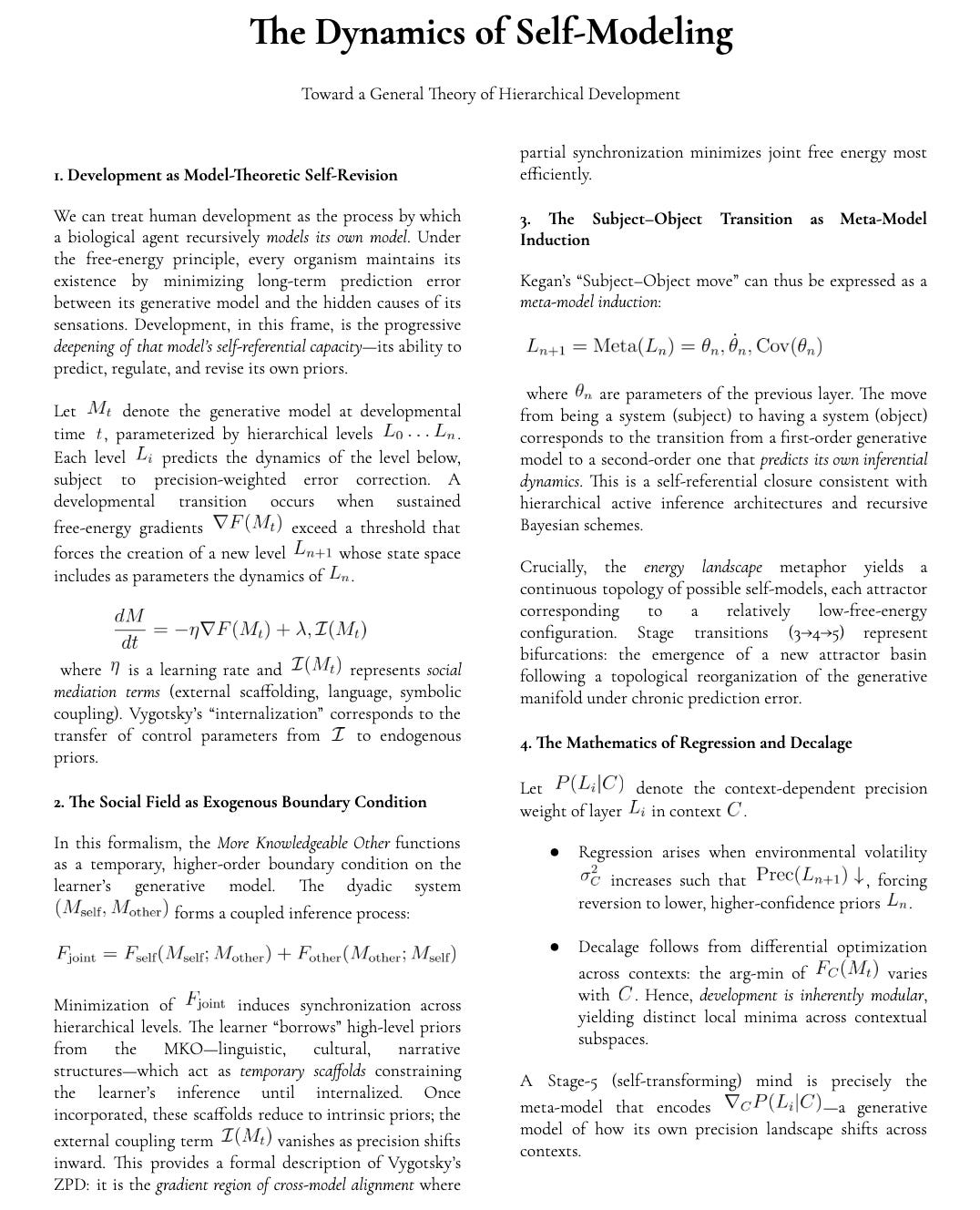
I propose a less linear picture: a landscape with a taxonomy of valleys. On this view, Kegan’s “stages” are attractor basins of a generative system, in which human prediction and action habitually come to rest when the terrain and the organism line up. The passage from valley to valley is not a jump so much as a traverse: one climbs the unstable ridge, buffeted by surprisal; one descends, sooner or later, into a new stability—or slides back into the old. Different traversals require different strategies, and different weather; we need patient guides.
To make this more than metaphor we must furnish an engine. For that, two bodies of thought are needed. From Vygotsky, the social blueprint: how functions first appear between persons and are then internalized within them. From Friston, the computational physics: the Free Energy Principle and active inference as a general account of how organisms hold themselves together against a world of potential surprise.
Synthesize these and the missing mechanics appear. One sees why the “messy middle” is messy; why stress does not so much reverse development as recruit older, cheaper solutions; why one may be “stage 4” about policy and “stage 3” about love without presenting a paradox. And one sees, too, how guidance works: why a certain kind of spoken scaffold at a certain time has power out of all proportion to its syllables. In short, the Vygotsky–Friston synthesis provides what Kegan’s admirable phenomenology lacks: a dynamics.
I. The Blueprint: Vygotsky’s Social Construction of Functions
Vygotsky’s genius was to treat the mind not as a private museum but as a workshop with doors open to the street. Higher psychological functions arrive, initially, as relations, conducted with others by means of signs—most consequentially, language. The difference between a tool and a sign is crisp: a tool acts on the world; a sign acts on the self. The child’s first pointing is orchestrated socially: someone else directs attention and action. Through repetition in a cooperative frame, the child learns to direct their own attention; what was interpersonal becomes intrapersonal. This is internalization.
Vygotsky couples the mechanism to a setting. The Zone of Proximal Development (ZPD) is that sweet domain of tasks not yet performable alone but readily accomplished with assistance. Within it, a More Knowledgeable Other (MKO) provides scaffolds—verbal frames, prompts, decompositions of action—that the learner initially leans upon and eventually incorporates. The process is not merely additive; it reorganizes. New mediational means alter the very form of thought.
We will need three pieces from Vygotsky: (1) the notion that functions originate as social procedures before they become private resources; (2) the centrality of signs as levers by which a system can act on itself; and (3) the ZPD–MKO arrangement as the context in which reorganizations are made tractable rather than catastrophic.
II. The Engine: Friston’s Free Energy and Active Inference
Friston’s Free Energy Principle (FEP) is austere in statement and fecund in consequence: living systems must minimize a bound on surprise to resist dissolution. One may treat the brain, under this rubric, as a hierarchical generative model of hidden causes: it predicts its inputs and then acts or updates to reduce prediction error. There are two principal routes: action, which alters the world to meet predictions; and perception (more broadly, model update), which alters predictions to meet the world. The practical logic is abduction—best-guess inference under uncertainty—guided by priors that are themselves the fruit of learning.
A critical control parameter in this picture is precision: the system’s estimate of a signal’s reliability. Precision-weighting governs what gets heard and what gets ignored; it effectively implements attention. At each level of the hierarchy, predictions descend; errors ascend. Where precision is high, an error speaks with authority; where it is low, the error is treated as noise. This simple dial—who is trusted, and how much—will explain a great deal of developmental life.
If one assumes a hierarchical generative model that is plastic (capable of adding or refining levels), that can weight precisions contextually, and that is continuously pressed by environmental complexity, one has the makings of a dynamics sufficient to carry Kegan’s forms.
III. Translation: Kegan in the Language of Inference
Let us map the principal entities.
Subject as high-precision prior. When a person is “Subject to” a structure (say, the Socialized identification with approval), the best rendering is: a high-level prior with such precision that it is functionally invisible. It does not appear as a proposition one could evaluate; it supplies the lens by which propositions are seen.
Object as modeled prior. To “make Object” is, computationally, to install a superordinate layer capable of predicting the behavior of the lower-level prior. The old structure becomes a thing with properties. One can notice it operating, anticipate its moves, and choose whether to amplify or inhibit it.
Stage transitions as hierarchical deepening. When the world persistently outruns a system (chronic prediction error), the system can sometimes add a level—constructing a more encompassing model that recontextualizes the inadequate one. This is Vygotsky’s internalization in a formal dress.
The familiar anomalies now admit of clean accounts:
The messy middle. Traversing from one attractor basin to another requires ascending an energetic ridge: prediction errors proliferate, confidence wobbles, precision estimates fluctuate. The phenomenology—confusion, anxiety, oscillation—is the felt trace of a model in flight that has not yet found purchase.
Regression. Under acute stress, the organism prudently reduces the precision of computationally expensive, recently learned, fragile high-level priors and increases the precision of older, cheaper routines that have historically limited surprise. This is not a deletion of development; it is a contextual re-weighting to weather a storm.
Decalage (domain specificity). A single organism can maintain multiple locally optimal attractors. In some contexts the self-authoring prior wins on free-energy grounds; in others, a socialized prior does. The capacity to select among priors by context is itself a developmental accomplishment—indeed, the hallmark of what Kegan means by “self-transforming.”
Above all, the synthesis clarifies the role of language and relationship in change. The well-timed utterance—“Notice how approval is running the show here”—delivered in the right relational envelope functions as a sign that allows the system to grasp itself. It does not merely persuade; it provides a handle by which a higher-level model can be built. The MKO’s guidance supplies provisional priors that the learner can borrow, test, and eventually make their own.
IV. A Short Tour Through the Landscape
Consider the passage from a Socialized to a Self-Authoring organization around the theme of approval.
Old equilibrium. The prior “My worth tracks others’ approval” carries high precision. Disapproval yields large errors, which are resolved through action: appease, conform, repair the social field. The prior rarely updates; the world does.
Destabilization. A new environment—say, a role that demands principled conflict—generates chronic error under the old prior. One cannot both maximize approval and discharge responsibility. Anxiety accumulates: the ridge has been reached.
Scaffolding. In the ZPD, an MKO—mentor, therapist, friend, text—offers a usable sign system: “There is a pattern here, and we can name it; there is a value system you can write and consult; there are experiments to run.” Language here is not commentary but equipment.
Construction. The learner builds a layer that predicts the behavior of the approval-seeking module and can attenuate or amplify it according to principle. Anxiety declines; the new basin holds. What was Subject is now Object.
We have, then, a worked mechanism for Kegan’s descriptive transformation, continuous with a general account of organismic self-stabilization.
V. What the Ladder Misses (and Why It Matters)
It was fashionable for a while to give the ladder a neuroanatomical gloss: identify “where Stage 4 lives,” as though it had a postal code. This is a category error. Stage-like organizations are not circumscribed blobs; they are modes of coordination across a hierarchy—patterns of precision and message-passing. They must be computed, not merely located. The temptation to treat stages as regions is an instance of what might be called developmental phrenology: attractive, simple, and wrong.
Equally misleading is the idea that an organism “has” a stage simpliciter. What it has are repertoires: habits of precision-setting, repertoires of signs, playbooks for action and update, and (when it is lucky and well-taught) the meta-capacity to choose among them with a tolerable grace. This emphasis on selection (which prior for which world) is close to Kegan’s spirit but quite different in mechanism: the ladders are are installed in a landscape, and asked to do more local work.
VI. A Note on Measurement: Priors as “Cognitive Intentions”
There has been some interesting empirical development in decomposing “stages” into finer-grained tendencies—Darren Stevens’ “Constructed Development Theory” being one such project. Without adjudicating particulars, the synthesis offers a straightforward reframing. The proposed “cognitive intentions” (e.g., internal vs. external orientation; self vs. partner; task vs. relationship) can be treated as lower-level priors in a generative model. A profile that shows heavy skew (say, overwhelmingly “external”) is, in our language, a signature of Subject: one prior assigned such precision that its competitors are silenced. A profile that shows flexibility across contexts—stability in the sense of reliable selection rather than rigid dominance—is a signature of Object: the presence of a higher-level controller capable of modeling and choosing among lower-level competitors. In this light, “balance” is not neutrality; rather, it is governance.
VII. Inducing Development: A Formal View of Guidance
If one accepts that the therapeutic or pedagogical relation is a ZPD in which sign-mediated functions are transferred, a precise practical program suggests itself. The sequence is two-part:
Destabilization by design. One introduces challenge exactly at the edge of competence so that the old prior reliably mispredicts. This can be done with questions, tasks, or perspectives that defeat the incumbent code without humiliating the person who lives by it. The point is to reduce the precision of the dominant prior—to make it a little less certain of itself.
Scaffolded construction. Into the ensuing, temporary instability one offers a scaffold: formulations, distinctions, and small experiments that can function as provisional priors. Crucially, these are not “beliefs we ask the client to adopt,” but handles that make the old structure graspable. The learner then tries them on in action; success is measured not in assent but in reduced surprisal across episodes of living.
The ratio is delicate: too much destabilization, and the system grabs whatever is nearest for relief; too little, and nothing budges. The ideal tool here is a clinical and pedagogical craft that can be described in the ordinary terms of timing, relationship, and fit.
VIII. The Stage Beyond Stages
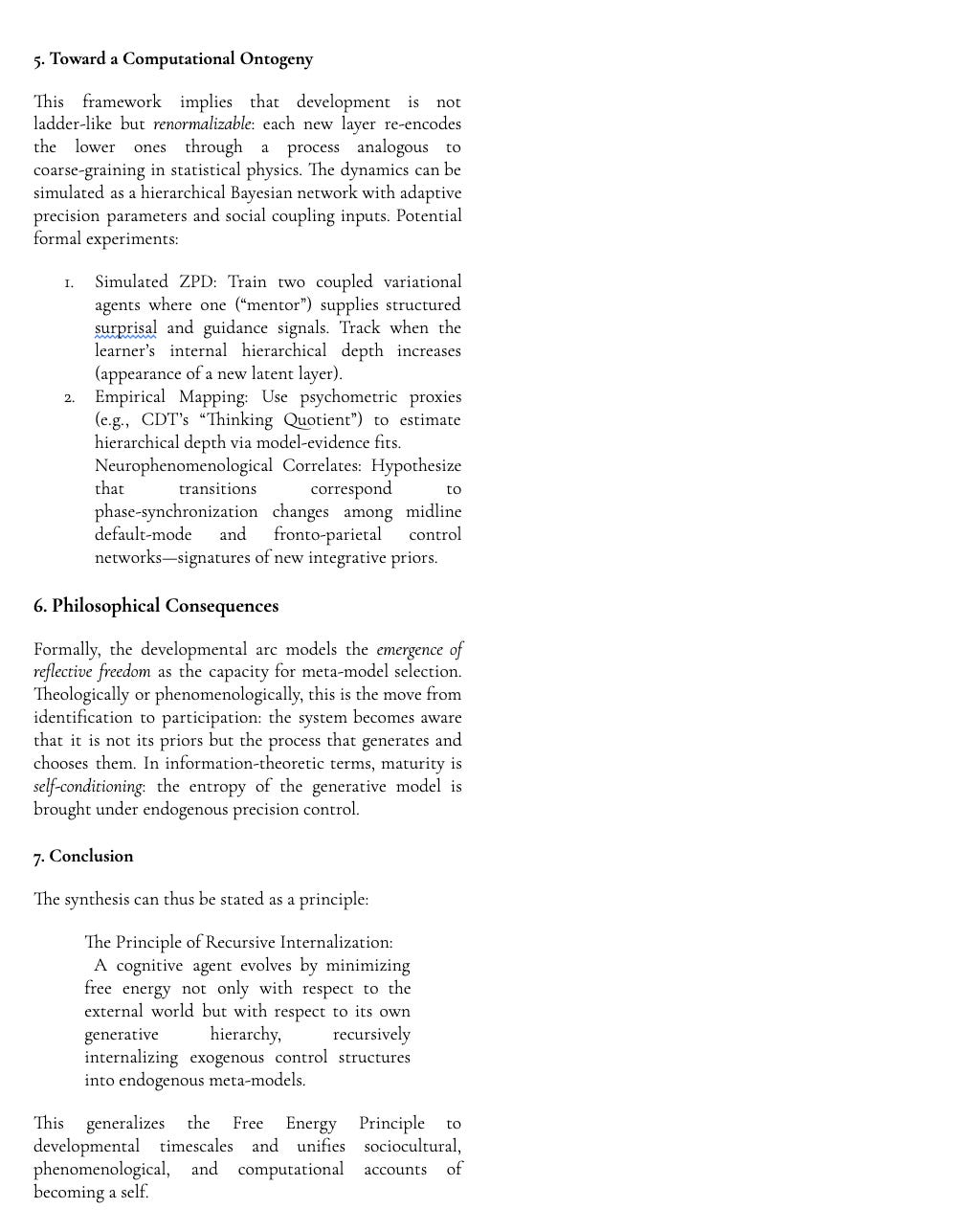
Many stumble over the description of Kegan’s fifth order, suspecting either mystification or redundancy. In the present register: a system capable of adding levels can, eventually, add one that models its own level-adding. The controller becomes meta-controller. The signature of this move is ease of re-contextualization. Such a system does not merely hold multiple encodings of policy schema; it holds, loosely, the procedures by which codes are adopted, revised, and retired, optimizing for bounded error growth. In our terms: it is skillful at contextual precision-setting and model governance, and it knows that it is so only contingently.
This is a way of walking the landscape that is appropriately wary of mistaking a valley for the world.
IX. A Few Practical Consequences
Education. If functions are born interpersonal, curricula ought to be built around guided participation in communities of practice, with explicit sign-systems taught as tools of self-regulation. Assessment should track not merely performance but the transfer of control from social scaffold to private competence—evidence that a prior has migrated from Subject to Object.
Leadership and organizations. Much dysfunction is a matter of mis-set precisions. A common failure mode in institutions is to assign overwhelming precision to reputational signals and trivial precision to ground truth. Healthy cultures teach members how to name these pressures, adjust weighting by context, and make selection among incompatible priors a shared practice rather than an occasion for moral panic.
Clinical work. Talk, when it works, is not “advice” but controlled access to signs. One is not in the business of persuading people of propositions; one is in the business of helping them build controllers. Exposure therapies, insight-oriented work, skills training—these can be laid out on a common template as different regimes of targeted destabilization and scaffolded construction.
Science of measurement. If one must use global “stage” labels, let it be with the explicit caveat that they are summaries of a distribution across domains. Better still to measure repertoires: which priors are available, how quickly a person can shift weighting among them, and how they perform under stress.
X. Against Phrenology, For Mechanics
We should be done with the habit of re-locating old typologies in new images—today a scan, tomorrow a connectome. The generative picture obliges us to ask after processes: how precisions are set; what constitutes evidence for a prior; how hierarchies are extended; which social arrangements are cost-effective for installing specific controllers. We are not, therefore, bereft of biology; we are asking for the right biology—the physiology of model selection and the neuromodulatory economy of attention, not a cartography of static stages.
Likewise, we might retire the moral melodramas that so often accompany developmental talk. To say that someone operates with a certain prior in a certain context is not to say they are defective, only that their system has found a local optimum given its history, incentives, and scaffolds. Change is hard not because people are perverse but because the ridge is steep and the weather uncertain.
XI. A Brief Coda on Style and Caution
The ladder metaphor, for all its failings, does a noble service: it makes visible the idea that form of mind matters and can change non-monotonically. The landscape metaphor asks for a slightly steadier posture, and more attention to footing. It frames development as the ongoing labor by which a living system earns its relative predictability without sealing itself off from novelty.
It also might inspire a certain degree of humility, epistemic or otherwise. If a sign at the right moment can alter a life, then the ones we casually supply—especially under color of authority—can mislead as well as guide. If precision is precious, then our institutions should attend to how they shout and to whom they listen. And if our goal is to help, then our immediate work is often to design better ZPDs: relations and settings in which the ridge can be crossed with fewer bruises.
Conclusion: From Rungs to Reliefs
Let me gather a thesis in one breath. Kegan gave us a disciplined phenomenology of developmental form, but not a physics. Vygotsky supplies the social blueprint by which new forms are built from shared practice into private capacity; Friston supplies the engine by which a system, perpetually minimizing surprise, constructs and selects among hierarchical models. From these pieces, the familiar anomalies become features: the messy middle as unavoidable instability; regression as adaptive re-weighting; decalage as the ordinary pluralism of a competent system. What looked like a ladder resolves into a relief map. Stages are not heights but hollows in which a self comes to rest.
The practical import is unromantic but liberating. We need fewer proclamations of altitude and more careful work on gradients, scaffolds, and signals. Development, in this key, is inseparable from pedagogy: the craft of laying out paths in difficult ground so that others, and occasionally we ourselves, may find a surer footing
.
What the hell, this is *so* good! Super insightful and also really well written, a pleasure to read